
Why Your Next Career Move Should Be a Non-Profit Board Seat

Board service is one of the more underused tools in a professional’s development toolkit and one of the more overlooked levers a company has for building better leaders. A few years into any sustainability or social impact career, you start hearing the same advice: join a board. It sounds like a good idea but most people hesitate because they are unsure what exactly they are committing to.
Let’s break down the basics and help decide if joining a board is right for you.
What a Board Actually Does
Strip away the jargon and a nonprofit board is the group legally and ethically responsible for the organization’s health. Board members are fiduciaries — they set the ethical, legal, governance and financial guardrails that keep the organization sound and they make sure it has the resources to pursue its mission.
Research points to three persistent gaps in board leadership:
Boards need to better assess expectations and performance
Gender, age and racial inequity remain despite broad awareness of the problem
Board members give generously themselves but fundraising is consistently rated the weakest part of board performance
None of these gaps close without more engaged, better-prepared people stepping into board seats.
Why It’s Worth Your Time
Board service pays out in three directions at once.
1. For you. You apply skills you already have to a mission you care about, while building new ones. Whether it’s budgeting, governance, public speaking, or strategic oversight, you can provide experienced insights or develop a valuable skill. It also puts you in a room with people you’d never otherwise meet: business owners, civic leaders, other executives, all working the same problem from different angles. That kind of network doesn’t come from another meeting on your own org chart.
2. For the nonprofit. They gain a committed volunteer with a professional skill set they likely couldn’t otherwise afford. They have a broader, more diverse bench of expertise around the table that can help achieve their mission.
3. For your employer. Companies that encourage board service see higher employee engagement, lower turnover and a form of leadership development. “Experiential learning” is genuinely hard to replicate in a classroom or on the job and HR functions consistently rate it as one of the best ways people grow.
How Leading Companies Treat It
A few companies have moved past “encourage” to “expect.” State Street built board service into its culture as both a community-involvement expectation and a leadership-development track. One VP put it well, “It forces the brain to work in a new environment and pushes those new muscles back into the office.” As a result, over 200 executives were placed on non-for-profit boards, and the company saw a jump in commitment among employees engaged in corporate responsibility work.
UPS takes a similar view, treating board placements as a way to build leadership capacity, expand executive visibility and deepen the company’s understanding of the communities it serves. Credit Suisse formalized it into a training program that’s placed more than 100 executives on boards over five years which accounted for 15% of the company’s total volunteer hours. Hershey surveys senior leaders on their interests and matches them to open seats through United Way.
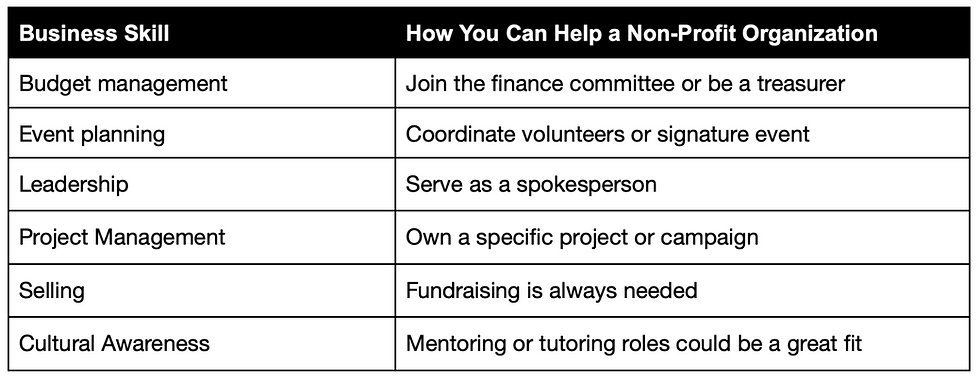
A Simple Skills-to-Service Map
If you’re not sure where you’d add value, work backward from what you’re already good at:
Where to Start
You don’t need to land on an audit committee on day one. Start with the cause you already care about, ask what the board actually needs right now and be honest about the time you can commit. You want to deliberately match skills to need, not say yes to the first invitation that comes along.
Ready to share your expertise and build your professional skills? What nonprofit board are you considering and why?


Comments